

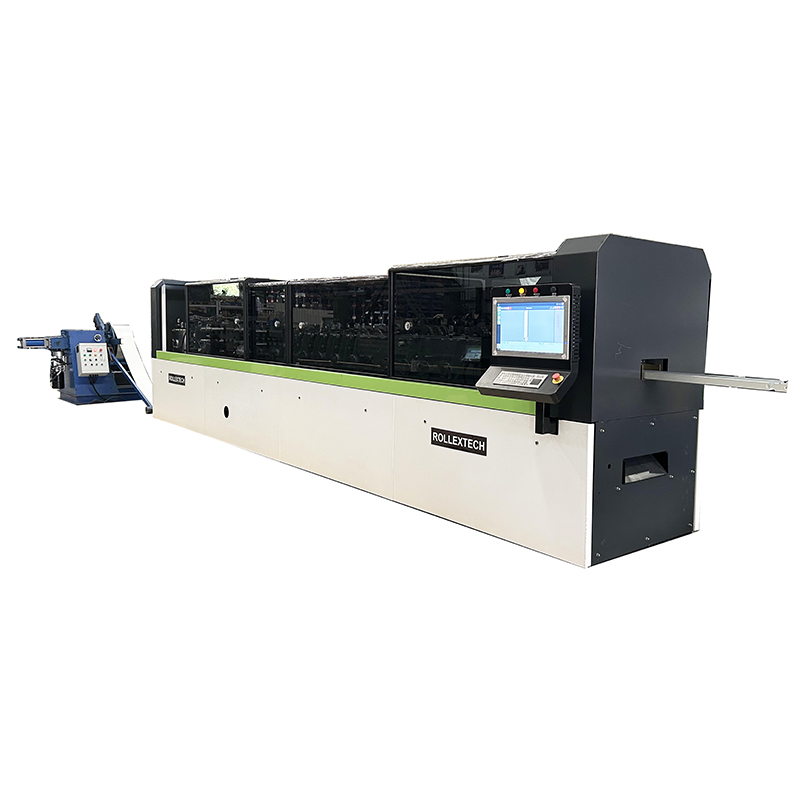

In modern steel structure construction, speed and structural efficiency determine project success. Industrial warehouses, commercial buildings, logistics centers, and multi-story steel structures all rely on one essential component: steel floor decking. Behind every precisely formed steel deck panel stands a specialized piece of equipment known as a stroj na pokládku podlahových krytin.
If you are involved in steel construction, roll forming manufacturing, or prefabricated building systems, understanding what a floor decking machine is—and more importantly, how to choose the right one—can directly impact your production quality, delivery timeline, and long-term profitability.
This guide explains in practical, straightforward terms what a floor decking machine does, how it works, what types are available, and how to evaluate the right configuration for your specific project requirements.
Why Floor Decking Machines Matter in Modern Construction
Steel-concrete composite floor systems have become standard in large-scale construction because they combine structural strength with faster installation. Steel decking panels act as permanent formwork for concrete slabs while also serving as tensile reinforcement once the concrete cures.
Without a reliable floor decking machine, it would be impossible to produce consistent, load-bearing decking profiles at an industrial scale. Manual fabrication simply cannot achieve the dimensional accuracy, rib depth precision, or production speed required in today’s construction market.
A floor decking machine ensures:
Accurate profile geometry
Consistent rib height and pitch
Stable material forming for high-strength galvanized steel
Efficient high-volume production
In other words, it transforms raw steel coils into structural components ready for construction use.
What Is a Floor Decking Machine?
A stroj na pokládku podlahových krytin is an industrial roll-forming system designed specifically to manufacture steel floor deck sheets from galvanized or coated steel coils. These sheets are engineered with ribs and embossments that increase bonding strength between steel and concrete.
Unlike simple corrugated sheet machines, a floor decking machine produces structural profiles that must meet strict load-bearing standards. The profile height, effective width, and rib design are not aesthetic features—they are structural elements calculated for span capability and shear strength.
A typical floor decking machine consists of several integrated systems:
A decoiler that holds and feeds the steel coil
A roll forming section where multiple roller stations gradually shape the material
A hydraulic or servo cutting system for precise length control
A PLC-based control system for automated operation
An output support table for finished panels
Each part works in coordination to maintain forming precision and dimensional consistency.
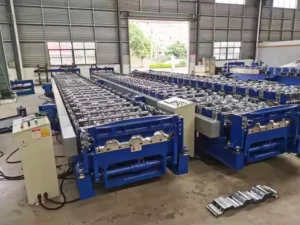
How Does a Floor Decking Machine Work?
The working principle of a floor decking machine is based on continuous cold roll forming. Instead of bending steel in one aggressive step, the machine gradually shapes the material through multiple forming stations.
The process begins when a galvanized steel coil is loaded onto the decoiler. The coil feeds into the roll forming section, where each pair of rollers slightly adjusts the profile. With every station, the steel moves closer to its final structural shape.
By the time it exits the final forming station, the flat sheet has transformed into a high-rib structural decking profile.
Length control is managed through encoder measurement systems, ensuring each panel matches exact project specifications. Once the target length is reached, the hydraulic cutting system performs a clean cut without stopping production flow in most modern configurations.
This gradual forming process minimizes internal stress, reduces deformation, and ensures high-strength steel maintains its structural integrity.
Types of Floor Decking Machines Available
Not all floor decking machines are built the same. The right machine depends on production scale, structural profile requirements, and budget.
Generally, machines vary in structural frame design, drive system, and profile capability.
Below is a simplified comparison of common machine configurations:
| Funkce | Standard Chain Drive Machine | Gearbox Drive Machine |
|---|---|---|
| Power Transmission | Chain system | Gear-driven system |
| Stability | Suitable for medium production | Higher torque stability |
| Údržba | Requires regular lubrication | Lower wear over time |
| Production Speed | Moderate | Higher speed capability |
| Long-Term Durability | Good | Excellent |
Gearbox-driven floor decking machines typically offer greater forming stability for thicker materials or higher production speeds. Chain-driven models are cost-effective and widely used in mid-scale production environments.
How to Choose the Right Floor Decking Machine for Your Project
Choosing a floor decking machine should never be based on price alone. It is a production investment that must align with structural requirements, output demand, and long-term expansion plans.
1. Understand the Required Deck Profile
Every construction project specifies a particular decking profile. Rib height, effective width, embossment pattern, and sheet thickness are structural calculations determined by engineers.
Before selecting a floor decking machine, confirm:
Required profile drawing and technical dimensions
Material thickness range
Steel grade (such as G550 high-strength steel)
Concrete load requirements
A machine designed for a 50mm rib height profile cannot easily produce a 75mm structural deck without major roller modification.
2. Evaluate Production Capacity
Production speed is not just about meters per minute. It relates to your project timeline and labor cost.
Consider:
Expected daily production volume
Future expansion requirements
Automation level (manual stacking vs automatic stacking)
If your projects involve large industrial parks or infrastructure developments, investing in a higher-speed floor decking machine reduces long-term production pressure.
3. Assess Machine Structure and Material Strength
The structural rigidity of a floor decking machine directly affects forming precision. Weak frames may flex during operation, leading to inconsistent rib geometry.
Pay attention to:
Frame thickness
Roller material (often 45# steel with heat treatment)
Shaft diameter
Surface hardening process
Machines built with stronger frames maintain alignment over years of operation, reducing maintenance frequency.
Key Technical Specifications to Review
When evaluating a floor decking machine, buyers should review technical data carefully. These specifications influence both performance and longevity.
| Parametr | Typical Range | Why It Matters |
|---|---|---|
| Tloušťka materiálu | 0.8–1.5 mm | Determines load capacity |
| Rychlost tváření | 10–25 m/min | Affects productivity |
| Roller Stations | 18–28 stations | Influences forming precision |
| Shaft Diameter | 75–95 mm | Impacts machine stability |
| Řídicí systém | PLC + HMI | Enables automation accuracy |
More roller stations generally allow smoother profile formation, especially for high rib structures. However, excessive stations without structural rigidity do not guarantee better results.
Common Mistakes When Buying a Floor Decking Machine
Many first-time buyers focus heavily on price comparison. While cost is important, overlooking structural and technical details can result in long-term losses.
Here are three frequent mistakes:
Choosing a machine without verifying compatibility with the required steel grade.
Ignoring after-sales service and spare part availability.
Underestimating installation space and power requirements.
A floor decking machine is not a short-term purchase. It is a core production asset. Making a rushed decision often leads to unexpected operational issues.
Application Scenarios of Floor Decking Machines
Floor decking machines serve multiple sectors within steel construction.
In industrial warehouses, decking panels provide fast slab installation across wide spans. In commercial high-rise buildings, composite decking reduces structural weight while maintaining strength. Infrastructure projects, including transport hubs and stadiums, also rely heavily on steel decking systems.
Because each project may specify different profile standards, manufacturers often customize floor decking machines according to regional construction codes.
Future Trends in Floor Decking Machine Technology
As construction becomes more automated and digitally managed, floor decking machine technology is evolving.
Modern developments include servo-driven forming systems for improved accuracy, automated stacking units to reduce labor dependence, and integrated monitoring systems that track production metrics in real time.
Some manufacturers are also integrating smart control systems that allow remote diagnostics and performance tracking. These improvements increase machine reliability and reduce downtime.
Sustainability is another growing focus. Efficient forming systems reduce material waste, while precision control ensures consistent profile production with minimal scrap.
Why Selecting the Right Floor Decking Machine Is a Strategic Decision
A floor decking machine influences more than sheet production. It determines whether your structural components meet engineering requirements, whether deadlines are achievable, and whether production remains stable over years of operation.
Choosing the right system means evaluating profile accuracy, structural strength, automation level, and long-term service reliability. It is about matching machine capability to project demand.
When properly selected, a floor decking machine becomes a stable and profitable foundation for steel construction manufacturing.
A floor decking machine is an essential roll-forming system used to manufacture structural steel decking panels for modern construction. It transforms raw steel coils into engineered components that support composite concrete floors in industrial, commercial, and infrastructure projects.
Understanding how a floor decking machine works—along with the differences between configurations—allows buyers to make informed decisions. Evaluating profile requirements, production capacity, machine structure, and technical specifications ensures long-term performance and return on investment.
In today’s competitive construction industry, precision, speed, and reliability are non-negotiable. Selecting the right floor decking machine is not just a purchasing decision. It is a strategic investment in production capability and structural quality.
